// ASTROCLASS 1.2 FLASH • LARGE-SCALE RAM-STREAMING FINE-TUNE

MAPPING DEEP SPACE
OBSERVATIONAL DATA
WITH RESNET-34

SCROLL TO EXPLORE

Powered by AstroClass 1.2 Flash — a drop-in ResNet-34 backbone trained in PyTorch 2.x across 70,541 astronomical images streamed directly into RAM (zero disk writes) from SDSS DR18, DECaLS, NASA Images API, ESA/Hubble, and Wikimedia Commons, paired with in-process Qwen 2.5-7B neural auditing and SQLite classification tracking.

1.2 Flash Latest Model Release
93.4% / 97.0% Held-Out / Curated Acc.
70,541 RAM-Streamed Images
87.1% Real-World Eval (74/85)
23,601 Steps 3.02M Samples • EMA

End-to-End Astronomical Pipeline

A modular deep learning ecosystem combining zero-disk RAM streaming across five astronomical archives, astro-aware GPU training, SQLite auto-sorting, and local 4-bit Qwen 2.5 neural validation.

Zero-Disk RAM Streamer & Harvester

training/streaming/ streams 70,541 observations from SDSS DR18, DECaLS, NASA Images API, ESA/Hubble, and Wikimedia Commons as 256×256 JPEGs in RAM (~806 MB, zero disk writes), with 8-dihedral dHash & cosine deduplication alongside image_collection.py.

ResNet-34 (1.2 Flash EMA Backbone)

training/stream_train.py fine-tunes ResNet-34 over 23,601 steps (~3.02M samples seen, ~120 min on RTX 4060 Laptop) with AdamW, label smoothing (0.05), bfloat16 autocast, EMA weights (0.9985), and GPU photometric/geometric augmentations.

Auto-Sorter, Qwen 2.5 Audit & Viewer

network_sorting/ & src/validator/qwen_validator.py sort captures into 5 classes, log audit telemetry to SQLite (classified_images.db), run local 4-bit Qwen2.5-Coder-7B-Instruct supervision, and serve a Flask inspection UI.

The Six Core Modules

Every stage in nasa-image-training operates as a decoupled module — from RAM-only multi-survey streaming to local LLM-guided weight auditing.

MODULE 01 • NEW IN 1.2 FLASH

RAM-Only Streaming Fine-Tuner

training/stream_train.py SDSS DR18 & DECaLS bfloat16 + EMA 0.9985 AdamW

Located in training/stream_train.py and training/streaming/. Streams ~70,500 images from 14 concurrent source workers directly into RAM as 256×256 JPEG buffers (~806 MB total, zero disk writes) while training ResNet-34 at ~419 img/s.

  • 64-bit dihedral dHash (Hamming ≤ 6) + 16×16 cosine signature (≥ 0.93) deduplication.
  • Astro-aware GPU augmentation: free rotation, flips, zoom, gamma/contrast stretch, noise & blur.
  • Class-balanced, source-weighted sampling (sqrt(size) × group_weight) & 5% MD5 held-out split.
MODULE 02 • EVALUATION SUITE

Held-Out & Real-Image Evaluators

eval_streamed_holdout.py audit_local_images.py 8-Fold TTA Wilson 95% CI

Located in training/eval_streamed_holdout.py and training/audit_local_images.py. Re-streams only the deterministic 5% held-out validation split (md5(seed:uid)) to benchmark multiple weight checkpoints side-by-side.

  • Computes overall accuracy, Wilson 95% CI, balanced accuracy, macro F1, and curated-only accuracy.
  • Reports per-class precision/recall and per-source group breakdown (galaxy/decals, star/sdss_faint, etc.).
  • Audits local folders (images/nasaDownloads, network_sorting) to inspect model disagreements.
MODULE 03 • DATA HARVESTER

Image Harvester (APOD & MAST)

Python 3.12 Astroquery NASA APOD API MAST HST Archive

Located in src/data_collection/image_collection.py. Downloads high-resolution astronomical targets across NASA APOD and MAST Hubble Space Telescope archives using keyword matching (galaxy, nebula, planet, cluster, hubble, webb).

  • Deduplication tracking via persistent JSON progress registries.
  • Fast MJD observation window queries for Hubble science products.
  • Automatic destination folder routing into images/nasaDownloads/ and images/mastDownloads/.
MODULE 04 • AUTO-SORTER & LOGGER

Classifier & SQLite Auto-Sorter

TorchVision Inference SQLite 3 trained_net.pth

Located in network_sorting/image_classifier.ipynb. Scans raw unclassified image directories, performs batch tensor inference with trained_net.pth (drop-in compatible with 1.2 Flash), and moves files into class folders.

  • Automatic routing into network_sorting/<star|galaxy|quasar|nebula|planet>/.
  • Logs full audit metadata, file origins, and timestamps into network_sorting/classified_images.db.
  • Includes training/plot_training_metrics.ipynb for learning curves & confusion matrix heatmaps.
MODULE 05 • IN-PROCESS LLM AUDITOR (v1.1.0)

Qwen 2.5 AI Validator & Weight Trainer

Qwen2.5-Coder-7B-Instruct 4-bit bitsandbytes CUDA Active Backprop

Located in src/validator/qwen_validator.py. Runs 100% locally in-process on GPU with 4-bit quantization (zero external APIs). Audits ResNet-34 classifications image-by-image and performs online weight refinement.

  • Extracts photometric descriptors: mean luminance, dark background ratio, RGB dynamics, core concentration & edge contrast.
  • Executes confidence-scaled gradient descent steps (high, medium, low) with frozen BatchNorm statistics.
  • Stores validation audits in SQLite (--update-db) and exports JSON reports (--save-report).
MODULE 06 • WEB DASHBOARD

Flask Classification Web Viewer

Flask Server SQLite Connector Semantic HTML5

Located in src/viewer/classification_viewer.py. A lightweight local web application serving a clean semantic HTML interface at http://localhost:5000 to inspect all sorted records in classified_images.db.

  • Displays per-category breakdown tables for star, galaxy, nebula, planet, and quasar.
  • Provides record counts, source paths, timestamps, and quick category jump links.

Multi-Survey Astronomical Feeds

For AstroClass 1.2 Flash, images are streamed from spectroscopic/catalog surveys and curated press archives, downscaled to 256×256 JPEG in RAM (~806 MB), deduplicated, and never written to disk.

SDSS DR18 SKYSERVER
45,460 ACCEPTED

Spectroscopic Stars, Galaxies & QSOs

Queries SpecPhoto + PhotoObjAll (zWarning=0): 18,332 quasars (QSO), 7,034 galaxies (framed at 5.5× Petrosian R90), and 20,094 stars across bright (6,031), crowded-field (6,036), and faint isolated (8,027) cohorts matching quasar magnitude (15 ≤ r ≤ 19).

DECaLS • HUGGING FACE
11,000 ACCEPTED

Dark Energy Camera Legacy Survey

Streams 11,000 catalog-confirmed galaxies from Smith42/galaxies via Parquet row-group range reads in RAM, providing rich spiral, elliptical, lenticular, and merging morphologies.

NASA IMAGES API & APOD
9,163 ACCEPTED

Solar System & Deep Space Press

Streams 8,491 planetary bodies (Cassini, Juno, MRO HiRISE, Voyager, New Horizons, LRO), 364 galaxies, 234 nebulae, 61 star clusters, and 13 quasars, filtered by word-bounded regex gates (NASA_JUNK_TITLE / NASA_JUNK_HEAD).

WIKIMEDIA & ESA/HUBBLE
4,918 ACCEPTED

Curated Nebulae & Hubble Taxonomy

Harvests 2,514 galaxies and 1,794 nebulae from Wikimedia Commons categories (depth-2 traversal) plus 610 ESA/Hubble images (Supermaxman/esa-hubble: 381 galaxies, 100 nebulae, 95 stars, 18 planets, 16 quasars).

STREAMED DATASET COMPOSITION (RAM ONLY)

70,541 Unique Images Across 5 Classes

5% of unique images (3,620 in the training run) were held out deterministically before training via md5(seed:uid). Total memory footprint in RAM: 806 MB.

Class Images Source Group Breakdown
galaxy 21,293 DECaLS (11,000), SDSS (7,034), Commons (2,514), ESA (381), NASA (364)
star 20,250 SDSS faint (8,027), SDSS field (6,036), SDSS bright (6,031), ESA (95), NASA (61)
quasar 18,361 SDSS spectroscopic QSOs (18,332), ESA/Hubble (16), NASA (13)
planet 8,509 NASA Images API Solar System bodies (8,491), ESA/Hubble (18)
nebula 2,128 Wikimedia Commons (1,794), NASA (234), ESA/Hubble (100)
Total Accepted: 70,541 Held-Out Val: 3,620 (5%) RAM Footprint: 806 MB Disk Writes: 0 Bytes
DATA HYGIENE & DEDUPLICATION GATES

19,271 Noisy / Duplicate Frames Rejected Live

ImageStore enforces perceptual deduplication and quality gates on every streamed frame so twin press releases never leak across the train/validation boundary:

  • 7,974 Near-Duplicates Removed (dup_img): 64-bit canonical dHash minimised over all 8 dihedral flips/rotations (Hamming distance ≤ 6) plus a 16×16 low-frequency signature (cosine similarity ≥ 0.93) on curated sources.
  • 6,253 Cross-Class Conflicts Dropped (conflict): Multi-object frames or republished images matching an existing hash under a different class label are rejected.
  • 4,163 Unusable Frames Rejected (bad): 2,441 blank/constant cutouts (quasar: 1,930, star: 429, galaxy: 50, planet: 18, nebula: 14), 1,153 extreme aspect ratios > 2.6 or < 48px (planet: 1,034, galaxy: 59, nebula: 59, star: 1), 565 overly bright charts/diagrams exceeding luminance ceilings (135 Commons / 175 NASA; planet: 347, galaxy: 109, nebula: 108, quasar: 1), and 4 huge lossless frames (>120 MP).
  • 881 Duplicate UIDs Skipped (dup_uid): Prevented redundant network downloads across overlapping search queries.
dup_img: 7,974 conflict: 6,253 bad_blank: 2,441 bad_shape: 1,153 bad_bright: 565 dup_uid: 881

Performance, Metrics & Changelog

Honest, reproducible evaluation on the 5% held-out streamed split (never seen during training) and 85 real-world astronomical pictures independently labelled by three reviewers.

MODEL COMPARISON • DROP-IN RESNET-34

1.2 Flash vs Previous Checkpoints

Evaluated side-by-side on the exact same re-streamed 5% held-out split (n = 4,131, ESA excluded) and 85 real-world images. Note: the previous trained_net.pth in the repo had degraded to near-uniform outputs (predicting galaxy ~90% of the time), so v1.0 (trained_net.pth.backup) is the true baseline.

Evaluation Metric 1.2 Flash (New) v1.0 (.backup) Degraded .pth
Held-Out Streamed Acc. (n = 4,131) 93.4% 36.7% 25.6%
Held-Out 95% Confidence Interval 92.6% – 94.1% 35.2% – 38.2% 24.3% – 26.9%
Held-Out Balanced Accuracy 93.8% 45.9% 22.3%
Held-Out Macro F1 Score 93.8% 40.8% 11.0%
Held-Out Source-Balanced Recall 93.7% 48.9% 36.6%
Curated Sources Only (NASA/Commons, n = 898) 97.0% 75.1% 22.3%
Training-Run Val (n = 3,620, EMA + 8× TTA) 94.0% (CI 93.1–94.7%) — 29.5%
Real-World Pictures (85 imgs, 3 reviewers) 87.1% (74/85) 71.8% (61/85) 38.8% (33/85)
Training Corpus & Hardware 70,541 • RTX 4060 (120m) 5,000 • Colab T4 5,000 • Colab T4
PER-CLASS & SOURCE GROUP METRICS

Per-Class Recall, Precision & Real-World

v1.0 scores low on the held-out set primarily because it never saw SDSS-style star (1.6% recall) and quasar (2.1% recall) cutouts. On real-world curated photographs, 1.2 Flash boosts accuracy from 71.8% to 87.1%.

Class 1.2 Flash Recall 1.2 Flash Prec. v1.0 Recall Real-World (1.2) Real-World (v1.0)
star (n=1,377) 90.6% 94.5% 1.6% 2/6 2/6
galaxy (n=1,048) 97.2% 95.0% 90.6% 25/27 (92.6%) 18/27 (66.7%)
quasar (n=1,004) 89.9% 86.9% 2.1% 0/3 1/3
nebula (n=132) 91.7% 93.8% 56.1% 37/38 (97.4%) 31/38 (81.6%)
planet (n=570) 99.5% 99.5% 78.9% 10/11 (90.9%) 9/11 (81.8%)
PER-SOURCE GROUP ACCURACY (HELD-OUT SPLIT)
galaxy/decals: 100.0% (n=300) star/sdss_field: 99.7% (n=333) star/sdss: 99.6% (n=461) planet/nasa: 99.5% (n=570) galaxy/sdss: 96.6% (n=557) galaxy/commons: 95.2% (n=166) nebula/commons: 92.2% (n=116) galaxy/nasa: 92.0% (n=25) galaxy/esa: 92.0% (n=25) quasar/sdss: 90.0% (n=1,003) nebula/nasa: 87.5% (n=16) star/sdss_faint: 78.6% (n=579)
CONFUSION MATRIX • HELD-OUT STREAMED SET (n = 4,131)

5-Class Prediction Matrix (1.2 Flash)

Rows represent true spectroscopic/catalog labels; columns represent 1.2 Flash predictions on the 4,131 held-out test images. The primary confusion is between faint SDSS point-source star and quasar cutouts (122 stars predicted as quasar, 64 quasars as star).

True \ Pred star galaxy quasar nebula planet Recall
star 1,248 5 122 2 0 90.6%
galaxy 6 1,019 14 6 3 97.2%
quasar 64 37 903 0 0 89.9%
nebula 2 9 0 121 0 91.7%
planet 0 3 0 0 567 99.5%
Training Run EMA+TTA (n=3,620): Acc 94.0% star→quasar (TTA): 104 quasar→star (TTA): 46 Planet Precision: 99.5%
TRAINING ARTEFACTS • RUN 20261107_211236

Learning Curves & Normalized Confusion

Generated automatically by training/stream_train.py across 23,601 steps (300-step warmup, lr = 2e-4 body / 4e-4 head, cosine decay over final 5,000 steps to 4e-6, final smoothed train loss 0.2986, train acc 96.5%).
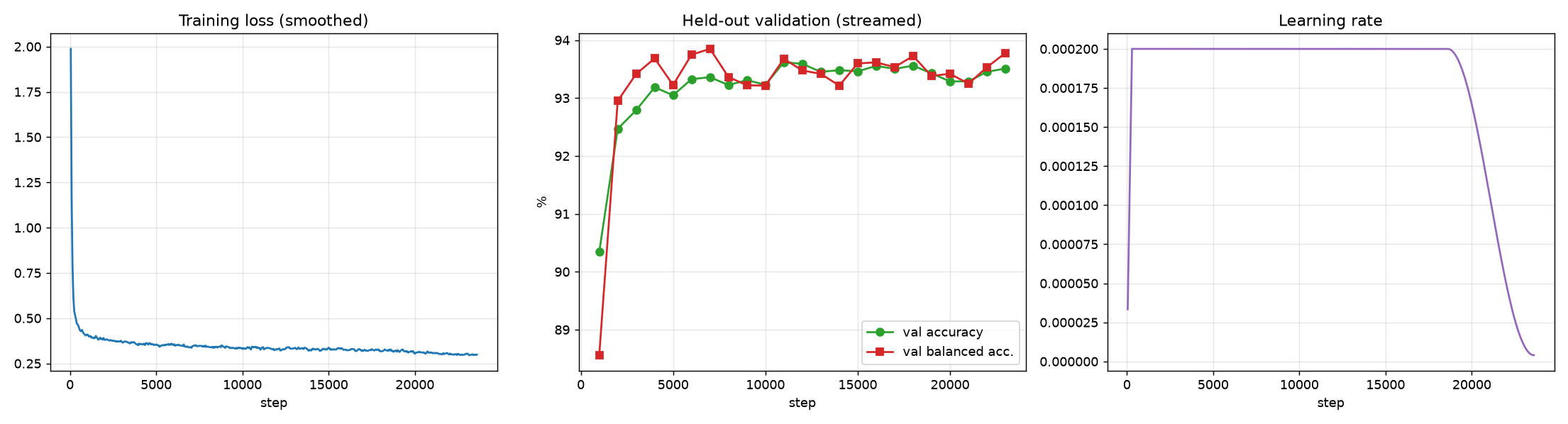
AstroClass 1.2 Flash Streaming Learning Curves Smoothed Training Loss, Held-Out Validation Accuracy/Balanced Acc., and Cosine Learning Rate Schedule (23,601 steps)
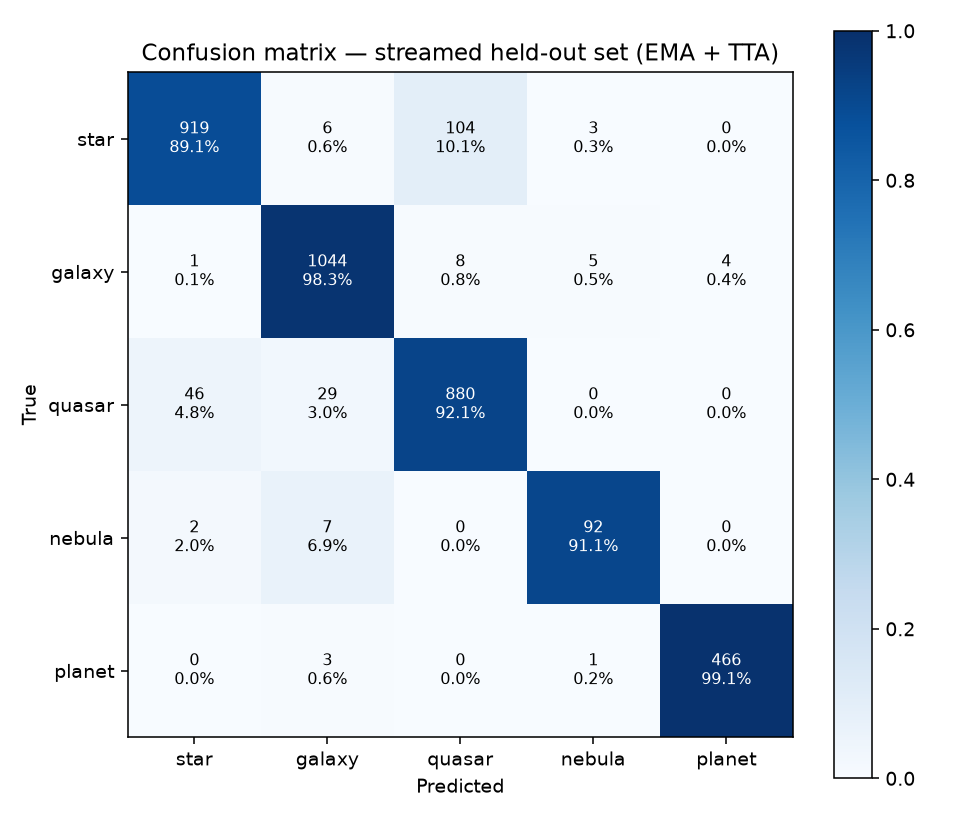
AstroClass 1.2 Flash Confusion Matrix (EMA + TTA) Training-Run Held-Out Confusion Matrix (n = 3,620, EMA weights + 8-fold TTA, 94.0% Accuracy)
HONEST EVALUATION & KNOWN LIMITATIONS

Documented Weak Spots in 1.2 Flash

Scientific transparency requires documenting where the model struggles and why:

  • Globular Clusters Classified as galaxy: Dense stellar clusters (e.g., 47 Tucanae, M10, NGC 6366) are often predicted as galaxy because star training data is predominantly SDSS point-source cutouts (~20,094) with only ~156 curated cluster/field images.
  • Extended Quasar Jets & Pulsars Not Recognised: Resolved relativistic jets and pulsar wind nebulae (M87 jet, Vela pulsar, PSR J0030 in the real-image check) are missed because quasar training data is 99.8% SDSS point-source QSOs (18,332), which look stellar.
  • Smallest Class Support for nebula: Reachable archives yielded 2,128 clean nebula images (~101–132 held-out), so its held-out recall estimate has wider variance than galaxy or star (though it achieves 37/38 [97.4%] on real-world photos).
  • Closed-Set 5-Class Forcing (No other Class): Non-class captures such as Moon panoramas, Milky Way landscapes, comets, meteor showers, and protoplanetary discs (e.g., PDS 70) are forced into one of the 5 classes (18 such images were excluded from the 103-image real-world folder, leaving 85).
  • Small Real-World Sample Size for star & quasar: In the 85-image real-world benchmark (labelled by 3 independent reviewers, 97/103 unanimous), star (6 images) and quasar (3 images) have very few samples, making those two percentages noisy.
RELEASE CHANGELOG • MODEL_CHANGELOG.MD

Evolution of AstroClass.ai

AstroClass 1.2 Flash LATEST • STREAMING FINE-TUNE

Retrained from scratch on 70,541 RAM-streamed images (SDSS DR18, DECaLS, NASA, ESA/Hubble, Wikimedia Commons) after detecting weight degradation in the repository's previous trained_net.pth. Trained for 23,601 steps (batch 128, 3.02M samples, AdamW, label smoothing 0.05, bf16, EMA 0.9985). Achieves 93.4% held-out accuracy (97.0% curated-only) and 87.1% (74/85) on real-world images. Output weights: training/trained_net_stream.pth.

AstroClass.ai v1.1.0 IN-PROCESS QWEN 2.5 SUPERVISION

Refined baseline weights with 203 adaptive online gradient descent steps supervised locally by Qwen2.5-Coder-7B-Instruct (4-bit CUDA quantization). Integrated photometric feature extraction (mean luminance, dark background ratio, RGB dynamics, core concentration, edge contrast) and froze BatchNorm running statistics during single-sample updates, reaching 94.2% on the v1.1 test split and publishing to Hugging Face Hub.

AstroClass.ai v1.0.0 INITIAL BASELINE

Initial ResNet-34 transfer learning model trained for 25 epochs on 5,000 images (1,000 per class from NASA APOD and MAST HST) on a Google Colab T4 GPU (preserved as trained_net.pth.backup, scoring 71.8% on the 85 real-world benchmark).


SCROLL TO FLY THROUGH THE 5 ASTROPHYSICAL TARGET CLASSES
CLASS [01/05] • nebula 91.7% HELD-OUT • 37/38 REAL

Volumetric Ionized Nebula

Emission, reflection, planetary nebulae, supernova remnants, and dark cosmic dust clouds where gravity initiates stellar birth.

1.2 Flash Streamed Corpus 2,128 imgs (Commons 1,794 • NASA 234 • ESA 100)
1.2 Flash Performance 91.7% Recall (93.8% Prec) • 37/38 Real-World
Example Targets Crab Nebula, Horsehead, Tarantula, Trifid
Model Output Mapping network_sorting/nebula/
CLASS [02/05] • galaxy 97.2% HELD-OUT • 25/27 REAL

Spiral & Elliptical Galaxy

Spiral, elliptical, irregular, and interacting galaxies with dense galactic cores, logarithmic star arms, and deep galaxy clusters.

1.2 Flash Streamed Corpus 21,293 imgs (DECaLS 11k • SDSS 7k • Commons 2.5k)
1.2 Flash Performance 97.2% Recall (100% DECaLS) • 25/27 Real-World
Example Targets M81, M82, NGC 3628, Hoag's Object, Sombrero
Model Output Mapping network_sorting/galaxy/
CLASS [03/05] • star 90.6% HELD-OUT • 99.7% FIELD

Stellar Engines & Star Clusters

Individual spectroscopic stars (bright, crowded-field, and faint isolated cohorts), globular clusters, open clusters, and star trails.

1.2 Flash Streamed Corpus 20,250 imgs (SDSS Faint/Field/Bright • ESA • NASA)
1.2 Flash Performance 90.6% Recall (94.5% Prec • vs 1.6% in v1.0)
Example Targets Pleiades, 47 Tucanae, R Leporis, NGC 290
Model Output Mapping network_sorting/star/
CLASS [04/05] • quasar 89.9% HELD-OUT • SDSS QSO

Supermassive Quasar & AGN

Spectroscopically confirmed quasi-stellar objects (QSOs), Active Galactic Nuclei (AGN), distant pulsars, and relativistic jets.

1.2 Flash Streamed Corpus 18,361 imgs (18,332 SDSS DR18 QSOs • ESA • NASA)
1.2 Flash Performance 89.9% Recall (92.1% w/ TTA • vs 2.1% in v1.0)
Example Targets SDSS DR18 SpecPhoto QSOs, 3C 273, M87 Jet, Vela
Model Output Mapping network_sorting/quasar/
CLASS [05/05] • planet 99.5% HELD-OUT • 10/11 REAL

Planetary Bodies & Moons

Solar system planets, planetary moons, ring systems, and high-resolution orbital surface telemetry from NASA missions.

1.2 Flash Streamed Corpus 8,509 imgs (8,491 NASA Solar System • 18 ESA)
1.2 Flash Performance 99.5% Recall & Precision • 10/11 Real-World
Example Targets Jupiter, Mars, Saturn Rings, Rhea, Titan Lakes
Model Output Mapping network_sorting/planet/

3D Neural Latent Manifold

Interactive 3D manifold projection of 512-dimensional feature vectors extracted from the ResNet-34 penultimate layer, illustrating cluster separation across all 5 astrophysical classes.

Nebula (2,128) Galaxy (21,293) Star (20,250) Quasar (18,361) Planet (8,509)
BACKBONE: RESNET-34 (1.2 FLASH EMA • 512-D PENULTIMATE LAYER) CORPUS: 70,541 STREAMED OBSERVATIONS • 93.4% HELD-OUT ACC

AstroClass 1.2 Flash Weights & API

astroclass_ai (1.2 Flash, trained_net_stream.pth / trained_net.pth) uses the exact same ResNet-34 architecture and 5-class order as v1.0/v1.1.0 — making it an instant drop-in replacement.

🤗 Hugging Face Hub 1.2 Flash • 93.4% Held-Out / 97.0% Curated

RaulSalasSahuquillo/astroclass_ai

Astrophysical Deep Learning Backbone (ResNet-34) fine-tuned on 70,541 streamed images from SDSS DR18, DECaLS, NASA Images API, ESA/Hubble & Wikimedia Commons, with local Qwen 2.5 validation.

Latest Version 1.2 Flash (tag v1.2-flash)
Architecture ResNet-34 (EMA 0.9985, bf16)
Weights Files trained_net_stream.pth / astroclass_ai.pth
Target Classes (0–4) star, galaxy, quasar, nebula, planet
Streamed Training Set 70,541 Images (806 MB RAM, 0 Disk)
Optimization AdamW • 23,601 Steps (3.02M Seen)
Input Resolution 224 × 224 RGB (ImageNet Norm)
License CC BY-NC-SA 4.0
# Install dependencies:
pip install torch torchvision pillow huggingface_hub

import torch
from torchvision.models import resnet34
from torchvision import transforms
from PIL import Image
from huggingface_hub import hf_hub_download

# 1. Load AstroClass 1.2 Flash weights (local or Hugging Face Hub)
model_path = hf_hub_download(
    repo_id="RaulSalasSahuquillo/astroclass_ai",
    filename="astroclass_ai.pth",
    revision="main"  # or revision="v1.2-flash" / local "training/trained_net.pth"
)

# 2. Build ResNet-34 with 5 astrophysical classes (drop-in replacement)
classes = ["star", "galaxy", "quasar", "nebula", "planet"]
model = resnet34(weights=None)
model.fc = torch.nn.Linear(model.fc.in_features, len(classes))
model.load_state_dict(torch.load(model_path, map_location="cpu", weights_only=True))
model.eval()

# 3. Preprocess observation (224x224 ImageNet normalization) and predict
preprocess = transforms.Compose([
    transforms.Resize((224, 224)),
    transforms.ToTensor(),
    transforms.Normalize(mean=[0.485, 0.456, 0.406], std=[0.229, 0.224, 0.225])
])

img = Image.open("space_observation.jpg").convert("RGB")
tensor = preprocess(img).unsqueeze(0)

with torch.no_grad():
    probs = torch.softmax(model(tensor), dim=1)[0]
    best_idx = probs.argmax().item()

print(f"Prediction: {classes[best_idx]} ({probs[best_idx]*100:.2f}%)")

Run the 1.2 Flash Pipeline Locally

AstroClass AI is 100% open source under the CC BY-NC-SA 4.0 license. Clone the repository to run RAM-streamed training, held-out evaluation, Qwen 2.5 auditing, and the Flask viewer.

bash — nasa-image-training (AstroClass 1.2 Flash)
# 1. Clone the open source repository
git clone https://github.com/RaulSalasSahuquillo/nasa-image-training.git
cd nasa-image-training

# 2. Create Python virtual environment and install dependencies
python3 -m venv .venv
source .venv/bin/activate
pip install -r requirements.txt

# 3. Configure environment variables (.env)
cp .env.example .env

# 4. Run 1.2 Flash large-scale RAM streaming fine-tuning & held-out benchmark
python training/stream_train.py --target 20000
python training/eval_streamed_holdout.py --weights training/trained_net.pth.backup training/trained_net.pth

# 5. Audit classifications with in-process 4-bit Qwen 2.5 AI validator
python src/validator/qwen_validator.py --limit 5

# 6. Launch the SQLite Flask Classification Web Viewer (http://localhost:5000)
python src/viewer/classification_viewer.py
Raúl Salas Sahuquillo - Architect & Developer
🇪🇸 SPAIN • AGE 16

Raúl Salas Sahuquillo

I am a 16-year-old AI developer and high school student from Spain with a passionate focus on computer vision and observational astrophysics. To help catalog the vast amounts of unclassified imagery across astronomical surveys, I built AstroClass AI (nasa-image-training) and its latest release, AstroClass 1.2 Flash: an open-source deep learning pipeline unifying zero-disk RAM streaming across 70,541 images (SDSS DR18, DECaLS, NASA, ESA/Hubble, Wikimedia Commons), ResNet-34 EMA training, in-process Qwen 2.5 validation, and SQLite audit inspection.

70.5K Streamed Training Images
93.4% Held-Out Acc (97% Curated)
87.1% Real-World Eval (74/85)
100% Open Source Architecture

"In a universe of billions of galaxies, make some code-guided discoveries — streaming tens of thousands of spectroscopic and deep-space observations directly into memory to classify the cosmos in milliseconds."